How To Build A Home Recording Studio In 2025 (Step-By-Step)

Whether recording vocals from singer-songwriters or producing for bands, setting up a home recording studio is essential to get the job done well.

Building a home recording studio setup doesn’t have to be expensive, with affordable equipment and software available for all processes.

This guide outlines the essential hardware and accessories required to build a high-quality home recording studio setup.


Get Early Access
To Promo Hype


Key Takeaways

  • Setting up a home recording studio can be achieved on a small budget thanks to the availability of affordable software and equipment.
  • Your choice of music genre will impact your home studio, with live instrument-based setups using different gear compared to electronic music setups.
  • Many home studios are ongoing works in progress, allowing producers to upgrade equipment and add new processes over time.


Home Recording Studio Setup: Understanding The Workflow

Before investing in your studio equipment, it’s essential to understand how it relates to the music production workflow.

Here’s an overview of the core workflow your studio will cover when you start producing music:

  • Songwriting and arrangements: Before you can begin recording music, you’ll need to write the song’s lyrics, melodies, and other instrumental arrangements. While not all music producers know how to read sheet music, a familiarity with the process will streamline your recording sessions.
  • Recording vocals and instruments: After the song has been written, the next step in the workflow is to record vocals and instruments in the studio. This can be done in group sessions for bands or by recording elements separately, ready for editing.
  • Editing MIDI and audio recordings: Once your material has been recorded, it can be trimmed and edited using music software, such as a digital audio workstation. Effects ranging from reverb and delay to chorus and other filters can be applied to create a unique sound for the track.
  • Mixing and mastering: The final stage of the recording studio workflow is mixing and mastering, which ensures that everything sounds professional across various sound systems. You can perform these processes on DAWs or pay for professional mastering services for your tracks.

This basic workflow varies depending on your music style, with electronic music production requiring less recording to achieve a polished sound.


Access leading music distribution and promotion services with a Promo Hype membership.


How To Build A Home Recording Studio In 2025 (Step-By-Step)

Setting up a home recording studio that delivers the desired results can be challenging, with multiple hardware and software options to consider.

Let’s break down the ultimate home recording studio setup, from preparing your space to choosing the best gear for your production workflow.


Step 1. Prepare Your Studio Space

The first step when designing a home recording studio is to select a room that has enough space and resources for your gear.

This begins with choosing a room that has minimal background noise, such as a spare room at the back of the house away from street noise.

Once your studio space has been decided, check for power sources and determine where you want ot position your main desk and other hardware.

If you’re using additional gear, such as mixing consoles and extra synthesizers, ensure your layout allows for a streamlined workflow.

Home recording studios oriented toward bands and singer-songwriters will also require space for artists to perform.

As such, cable management must be efficient and discreet to avoid accidents, and dedicated vocal recording booths can be added.

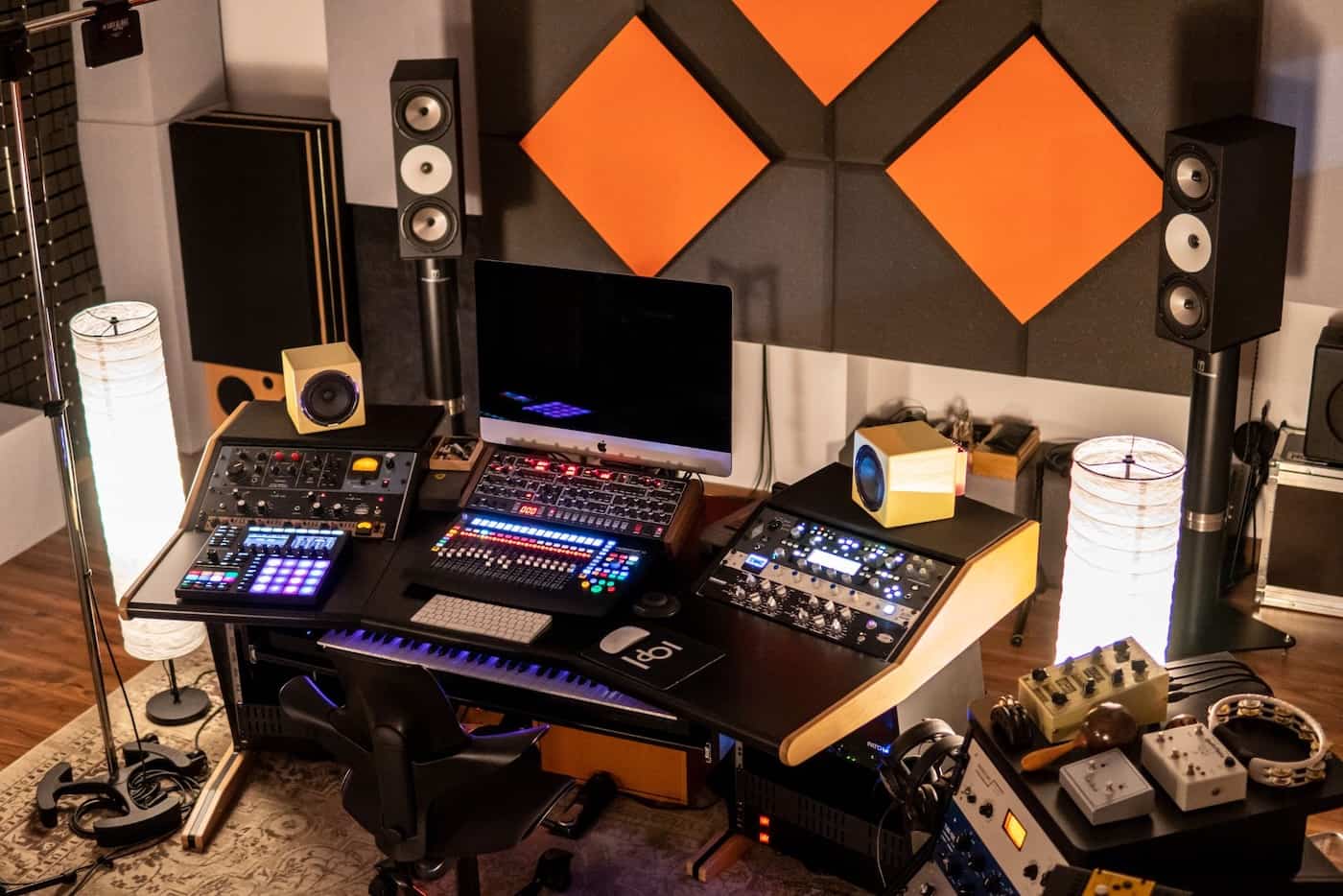
If your budget permits, you can invest in a dedicated music production desk with stands for monitor speakers and multiple shelves for gear.

This will integrate your recording workflow with other music production processes without leaving a centralized hub.


Step 2. Invest In A Reliable Computer

Windows and Mac computers are equally capable of running a home recording studio, and your preference will influence your software options.

Before investing in a new computer, you can check your existing device’s specifications to see if they’re up to the task.

If it doesn’t meet the minimum specification requirements for your chosen software, you can upgrade your RAM and other components.

This is a more affordable option that can be performed over time to upgrade computers to streamline your workflow incrementally.

For those with a higher budget for their home recording studio, dedicated music production PCs are available, offering optimized specifications.

This ensures your system delivers low-latency audio performance and stability in your preferred DAW when running large projects.


Step 3. Choose A Digital Audio Workstation (DAW)

A digital audio workstation is the central hub through which your recordings will be edited, mixed, and arranged into complete songs.

The best DAWs feature intuitive user interfaces with streamlined workflows that enable the creation of complex arrangements on projects.

You can start with a free-to-use DAW or use professional-level software that matches industry standards for recording studios.

There are also emerging AI-powered DAWs that are changing the way producers approach the overall music production process.

Let’s examine some of the primary considerations when choosing a digital audio workstation for your recording studio:


Computer Operating System

While some DAWs offer cross-platform compatibility, Apple users have the option to choose dedicated software for their operating system.

Logic Pro X for Mac is one of the best DAWs on the market, offering a comprehensive suite of tools for recording, editing, mixing, and mastering tracks.

Alternative DAWs that offer comparable tools include Cubase Pro, which is often used for film scoring, and Pro Tools.

The latter is the industry standard recording software for many professional studios, with a strong emphasis on multitrack recording.


Available Budget

If you lack the funds for a high-end DAW, there are several free-to-use options available for Mac and Windows platforms.

For Mac users, GarageBand is the go-to software for singer-songwriters and bands, with an impressive suite of tools.

Audacity is another excellent DAW packed with features that are free to use and can be installed on Windows computers.

You should also consider payment options and whether you prefer a monthly subscription or a one-time payment.


Style Of Music

Different DAWs have their strengths and weaknesses that lend them to stronger applications for various music genres.

If your studio is designed for recording live instruments and vocals, Pro Tools and GarageBand may be the best options for you.

On the other hand, electronic music producers will benefit from Ableton Live or FL Studio, which are specifically designed for this style.

Fortunately, DAWs can be enhanced through both paid and free VST plugins that emulate traditional hardware, thereby opening up creative possibilities.


Step 4. Add An Audio Interface

To direct your recordings through music production software, you’ll need an audio interface that includes the necessary connections.

The best audio interfaces incorporate a variety of inputs for connecting microphones and instruments, ensuring they are ready for recording.

While a budget-friendly audio interface will suffice for most beginner studio setups, more advanced options are needed when recording many musicians.

As such, checking the number of inputs should be one of your top priorities when choosing an audio interface for your studio.

An audio interface also features MIDI connectivity, allowing it to be used with a MIDI keyboard or other MIDI-based studio hardware.

Here’s an overview of other factors to consider when choosing an audio interface for your home recording studio:

  • Input and output types: In addition to verifying the number of inputs and outputs on an audio interface, you should also confirm their types. XLR and TRS formats are used for microphones, with MIDI inputs and outputs for different headphone jack sizes should also be checked.
  • Quality of the preamp: An audio interface also requires a high-quality preamp to ensure the best possible sound quality for your projects. This is especially relevant when recording singing and acoustic instruments using dynamic microphones.
  • Sample rate and bit depth: When it comes to sample rates and bit depth, the higher the value offered by an audio interface, the better the performance.
  • Low-latency performance: Whether using a basic USB audio interface or a professional-level model, low latency is essential. This ensures sound waves are heard instantly through headphones or speakers without any delay.

You can assess the potential of a given audio interface by reading through reviews and feedback that address these factors.


Get Early Access
To Promo Hype


Step 5. Invest In Microphones

High-quality microphones are essential for bringing your songwriting capabilities to life and accurately recording vocals and instruments.

There are three primary types of microphones used in music production: condenser microphones, dynamic microphones, and ribbon microphones.

Let’s break down each of these microphone types and their typical applications when recording audio for music projects:

  • Condenser microphones are the most common type of microphone used for recording vocals and musical instruments. They come in two formats: small-diaphragm and large-diaphragm. The latter format delivers the best audio quality across a broad range of recording techniques and instruments.
  • Dynamic microphones: More often used for live performances, dynamic mics can handle higher volume levels of sounds without creating distortion. While they can also be used in a recording room for audio production, the condenser microphone will get the most use.
  • Ribbon microphones: A less common type of microphone is ribbon mics, known for producing a mellower, softer sound compared to other studio-based microphones. This softness lends ribbon microphones to recording vocals, choral arrangements, and instruments like acoustic guitars.

To select the best ones, research various guides on choosing studio microphones to find models that match your budget and needs.

Over time, you can replace budget microphones with higher-quality models and introduce additional microphones to record more instruments simultaneously.


Step 6. Incorporate A Control Surface

Setting up a home recording studio requires a robust control surface and interface for managing a range of production processes.

Most studios are designed around a central control surface, which incorporates the knobs, sliders, and other controls necessary for production.

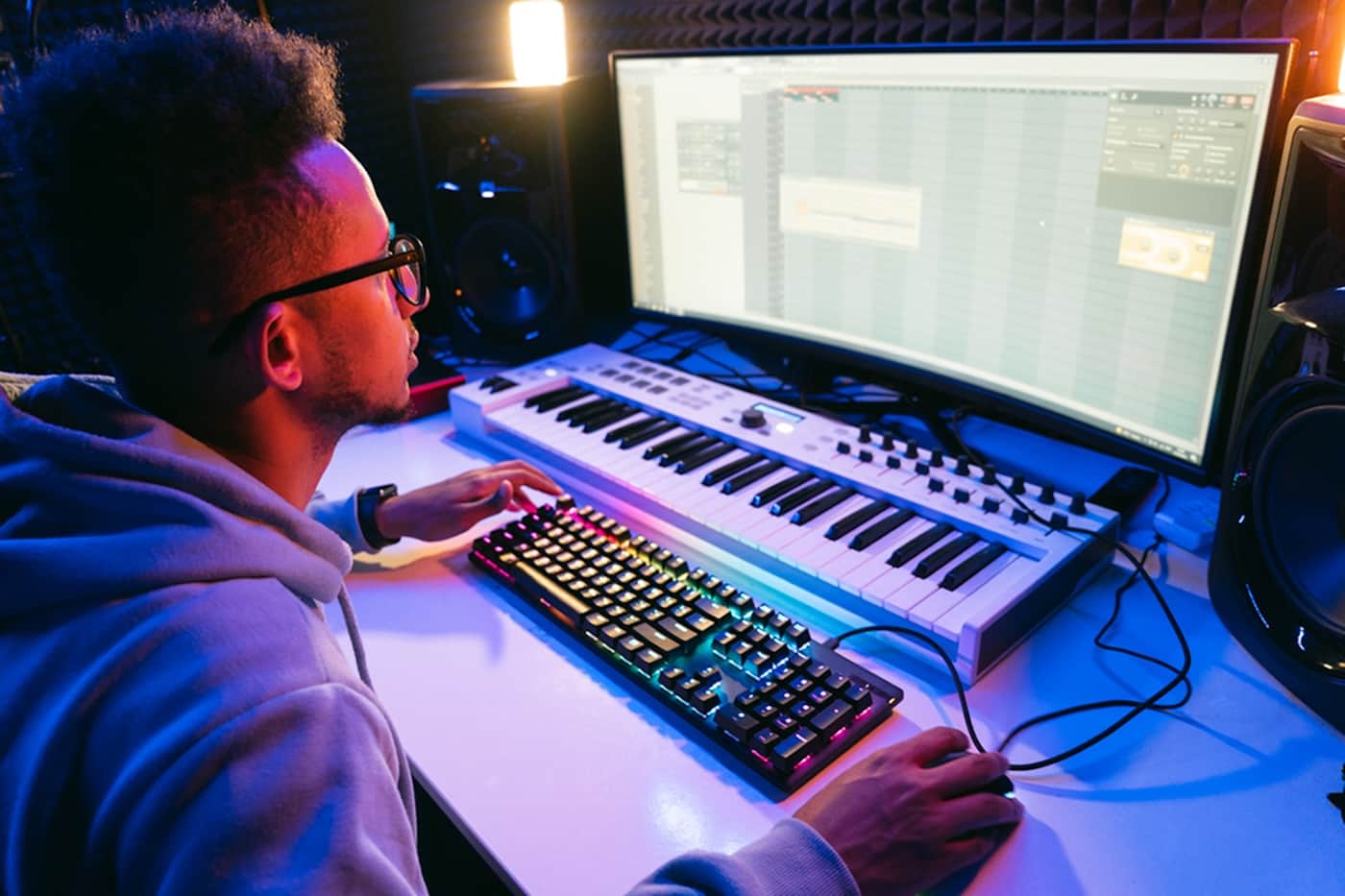
This can be as simple as a MIDI keyboard, which users can map to desired parameters and controls for tools in their DAW.

Such controllers allow producers to play virtual instruments and manipulate other external audio sources with tactile and responsive controls.

These devices enable an organic approach, whether by applying filters to specific chord types or adjusting stereo width across samples.

Some home recording studios also feature dedicated mixing desks that allow for EQing across multiple inputs.

While famous producers are known for using bespoke consoles, numerous affordable options are available for a home recording studio.

Reputable manufacturers such as Behringer, Novation, PreSonus, and Allen & Heath all offer models tailored to different budgets and requirements.


Step 7. Use Monitor Speakers & Headphones

When setting up a new home recording studio on a budget, it can be tempting to use standard hi-fi speakers in your setup.

While this will save money, dedicated studio monitors are still necessary for critical listening and ensuring that mixes accurately replicate the desired acoustic properties.

This is because studio monitors are designed for a flat frequency response, whereas hi-fi speakers typically enhance aspects like bass frequencies.

By investing in dedicated studio monitors, you’ll get the most out of the best music production equipment used in your setup.

Likewise, high-quality headphones are also a worthwhile investment, particularly if you’re producing at night and don’t want to disturb neighbors.

By using high-quality speakers and headphones in post-production, you can create music worthy of being signed to a record label.


Step 8. Acquire Cables & Accessories

It goes without saying that a home recording studio requires a series of cables to connect everything together.

The range of cables required will vary based on your setup, from straightforward connections to complex rigs for recording drums and instruments.

For your condenser mic setup, XLR cables are used, while 1/4″ cables can be used for instruments with DI boxes to use with XLR inputs.

In addition to cables, you can select a range of accessories to streamline your setup, including microphones and keyboard stands.


Step 9. Consider Additional Hardware

A home recording studio offers endless scope for additional hardware to expand your creative choices when making music.

This can include physical hardware versions of popular VST plugins for audio compression, limiters, and other effects units.

It can also cover drum machines, synthesizers, samplers, and other hardware typically used in the production of electronic music.

Studio hardware for band productions can range from electric guitar amps and a drum kit to pianos and other traditional instruments.


Step 10. Soundproof With Acoustic Treatment

The final stage when setting up a home studio is applying room treatment to control sound reflections in your recording room.

Acoustic treatment doesn’t have to be costly, and you can focus your panels in limited areas and still achieve great results.

There are methods you can adopt to make homemade acoustic panels, as well as cost-effective alternatives from dedicated vendors.

It’s an essential element of a home studio to ensure your music sounds polished and ready to submit to radio stations.


Read next: Learn how to make music with this step-by-step guide.


How Much Does It Cost To Build A Home Recording Studio?

There’s an extensive selection of free and paid software, as well as budget-friendly and professional gear, to use in a home recording studio.

This makes it possible to set up a home recording studio on a tight budget or invest thousands of dollars in a high-end setup.

Here are some factors to consider when budgeting for your home recording studio setup:

  • Room size and shape: Many hobbyist producers set up their first studio in a small bedroom, which makes it easier to work with more affordable gear. The room size and shape will also impact your spending on acoustic treatment and other recording studio features.
  • Available budget: If you’re setting up a studio on a tight budget, there are affordable options and free music editing tools you can use. On the other hand, if money is no object, investing in high-end microphones, studio monitors, and other professional-grade equipment will significantly enhance the experience.
  • Music production experience: Your level of experience with music production will also impact the budget for your home recording studio. Newcomers may want to stick with easy-to-learn basic tools, while those with more experience may require gear with more in-depth features.

If you begin with a budget-friendly studio setup, you can upgrade various components over time to improve its quality.


Average Costs For Beginner, Intermediate & Professional Studios

We’ve covered some of the primary considerations when budgeting for software and equipment for your home recording studio.

Here’s a breakdown of the average costs for a studio for beginners and those with intermediate or professional-level experience:

  • Beginner home recording studio: Building a bare-bones home recording studio that incorporates a free DAW and other free resources is relatively inexpensive, with a budget range between $500 and $1000.
  • Mid-tier home recording studio: If you want to invest in additional hardware, a MIDI keyboard, and a comprehensive DAW with a powerful computer, you can expect a budget range of $1000 to $3000.
  • Professional standard recording studio: Those with large budgets who want to emulate the professional studios used for the most popular music genres can expect to pay upwards of $10,000.

Researching your options within your available budget will ensure your home recording studio covers the features needed for your musical style.


Optimizing Your Home Recording Studio Setup

Investing in home recording studio equipment means setting everything up for optimal performance and a streamlined workflow.

Let’s break down some of the essential tips for optimizing a home recording studio:

  • Optimize the placement of studio monitors: Evaluating the quality of your recordings and mixing correctly requires the correct placement of your studio monitors. You can reference online guides to ensure your monitors are positioned for optimal stereo mixing and other processes.
  • Arrange equipment for an efficient workflow: If your home recording studio includes multiple instruments and microphone setups, it needs to be efficiently arranged. This will ensure that everything is easily accessible without singers and musicians getting in each other’s way.
  • Create a comfortable environment for sessions: Recording vocals and other instruments can be time-consuming, particularly when working on several tracks. If your studio has the space, consider including comfortable chairs or a couch for relaxation between takes.
  • Consider a soundproof booth for recording vocals: Acoustic treatment is a great starting point for a recording space, but complete soundproofing will elevate your results. You can also consider creating a dedicated, soundproofed vocal booth for full control over your environment.
  • Learn from great music producers: While most people lack the funds for a truly professional recording studio, you can still learn from the experts. Check out the workflow and setup of music industry producers like Quincy Jones and other leading figures.

As you work on more projects, you can incorporate any music production tips you get from your collaborative partners.


Reach New Fans With Promo Hype

Once you’ve mastered the art of recording music, it deserves to reach the broadest possible audience of music lovers.

With Promo Hype, you can reach millions of fans worldwide through a comprehensive range of tools for independent artists.

By becoming a Promo Hype member, you can:

  • Distribute on all major music streaming platforms: Maximizing your music’s reach requires distribution on all major music streaming platforms. Promo Hype members can schedule and release tracks on Spotify, Amazon Music, TIDAL, Apple Music, and other platforms.
  • Streamline marketing initiatives with the Promotional Toolkit: Releasing excellent tracks requires a strategy for promoting your music to your target audience. With Promo Hype’s Promotional Toolkit, you can effectively manage your marketing budget and allocate resources where they yield the best results.
  • Analyze performance and growth with the personalized Dashboard: Keeping track of your music’s performance across multiple streaming services can be a challenge. With Promo Hype’s Dashboard, members can analyze the performance of their music library through a range of powerful metrics.
  • Engage with Promo Hype members in the Community: Collaboration is the key to success for independent artists looking to build a following. Promo Hype’s Community brings producers and musicians together to discuss collaboration and share insights into the creative process.

With in-depth tools and information to help drive your career, Promo Hype is an essential platform for successful independent artists.


Summary

Creating exceptional music involves investing in the necessary gear and software, as well as setting up a dedicated recording space.

Whatever your production style, this guide will help you set up a home recording studio that exceeds expectations.

The more sessions you hold, the more you can refine your workflow and upgrade equipment to produce professional-sounding music.
Music Production 101: The Ultimate Beginner’s Guide to Making Music in 2025

Mastering the art of music production is an extremely rewarding and creative experience. There are many resources to help you learn how to produce music and build a powerful studio setup that delivers professional-sounding results.

However, our beginner-friendly guide to music production covers all the processes, equipment, and software necessary to create exceptional tracks all in one place, so you won’t need to look any further.


Get Early Access
To Promo Hype


Key Takeaways

  • Learning music production is an exciting process that can transform musical ideas into polished tracks, ready to be shared.
  • The availability of free and affordable software makes it possible to produce exceptional music on a tight budget.
  • Mastering music production has never been easier, thanks to the free tutorials and resources covering all aspects of the process.
  • Partnering with other artists is an excellent way to build a skill set and share the results across social media.
  • Once you’re confident in your production skills, you can explore career opportunities and other ways to monetize your music.


What Is Music Production?

Music production is the process of transforming a musical concept into a complete track, incorporating a series of important stages.

These stages include songwriting and composition, as well as recording vocals and instruments, and editing them using music production software.

As the global music industry has continued to expand, interest in music production has never been stronger.

Likewise, the emergence of affordable music production tools has made the process accessible to a broad audience.

Combined with streaming platforms, the result is an explosion of popular music genres and opportunities for artists to shine.


Read more: How to get signed to a record label.


The Core Processes Of Music Production

As with most types of creative expression, a set of core elements is involved that ensures high-quality results.

Here’s an overview of these elements and how they correspond with one another when producing music:

  • Songwriting and composition: While not all music production involves songwriting and composition, many producers play a key role in this aspect.
  • Recording instruments and vocals: Music production for bands and singers encompasses the recording process, which captures vocals and traditional instrumental performances.
  • Editing audio files: Once the recording sessions are complete, the music producer selects and edits the best takes in their chosen software.
  • Mixing individual elements: With the audio files arranged, the next step is to combine these elements to add effects and balance the frequency ranges.
  • Mastering the final mix: The last stage of the music production process is mastering, which boosts the volume and overall sound and impact of the final product.

Some producers also use AI tools, although the majority show a strong resistance to the technology outside of limited applications.


What Does A Music Producer Do?

Before you can begin working on tracks, you need to understand what a music producer does to bring musical ideas to life.

The music production process draws on other skills that bring the writing, recording, editing, and mixing processes to life.

It also requires a range of soft skills, fostering a collaborative mindset and mutual learning when working with other musicians.

Let’s explore these roles in more detail and how they can help improve the overall music production process:

  • Project conceptualization: The roles of a music producer and a record producer are often blurred, particularly when it comes to conceiving the themes and tone of an album. This includes forming the artistic vision that drives the production and dictates the instruments and production methods to be used.
  • Sound design: Crafting the soundscape of music is another typical requirement of a skilled producer, bringing depth and shape to the piece. This element is heavily focused on the use of synths, effects, and other instruments to boost the emotional resonance and help the listener connect.
  • Technical troubleshooting: While music production is partly an artistic endeavor, it also involves technical troubleshooting to ensure that all equipment functions as intended. This can include resolving issues with the audio interface and plugins, as well as addressing CPU overload and other computer-related problems.
  • Asset management: Throughout a few recording sessions, the volume of data collected from vocal and instrumental recordings can become considerable. The music producer is expected to manage these and other assets by establishing folder structures and file naming conventions to make the best takes easy to find.
  • Managing collaborations: Having strong interpersonal skills is essential for producing music collaboratively, such as in bands. This includes planning and scheduling recording sessions, arranging suggestions from artists, and keeping everyone informed.

Whether you’re producing alone or with others, developing these skills will streamline your process and improve the quality of your music.


Check out Promo Hype’s features.


Music Production 101: A Step-By-Step Beginner’s Guide to Making Music In 2025

If you’re looking to make simple tracks for fun or partner with other musicians, the core process of music production is the same.

Let’s begin this step-by-step guide to music production, from defining your project to using software and instruments to bring it to life.


Step 1: Plan Your Project

Creating a clear vision for your music project is crucial for determining the gear and processes you’ll need to achieve excellent results.

This begins with your chosen music genre, breaking down the instruments and other tools needed to achieve your desired sound.

If you’re collaborating with others, this project outline will ensure everyone is on the same page before you start producing music.

Collecting reference tracks of relevant songs from great producers will give a clearer impression of what you’re hoping to achieve.

You can also create a song structure template, breaking down the verse-chorus sections with notes on instrumentation and lyrics.

From here, you can build up a list of samples, effects, and other assets you’ll need, and where they fit into the track.

While this project outline should be flexible to allow for flashes of inspiration, it nevertheless provides a roadmap that streamlines production.


Step 2: Invest In The Right Gear

With a clear idea of what your project requires, you can begin acquiring the appropriate equipment to deliver on your vision.

Regardless of your music genre, there are several core items of music production gear that most producers will use.

Here’s the basic equipment you’ll need to start making music:

  • A computer or laptop to run your music production software and store audio files and other assets used in the song.
  • High-quality monitor speakers/headphones to assess sound quality and fine-tune all of the elements into a final mix.
  • Microphones for recording vocals and other instruments, as well as collecting unique samples and sound effects.
  • An audio interface to connect instruments and microphones to your computer so that they can be recorded in high-quality audio.
  • A MIDI keyboard, so you can take advantage of the MIDI interface and perform melodies and chords, and edit audio parameters.

If your budget permits and you’re considering recording bands, a home studio mixer is another excellent addition to your setup.

You can start with entry-level equipment if you don’t have a budget, and then upgrade or add new gear as your production journey evolves.


Step 3: Use Digital Audio Workstations & VST Plugins

Editing and mixing your audio files requires a digital audio workstation, through which individual tracks are altered and refined.

There are many excellent digital audio workstations available, ranging from fun, free-to-use versions to fully-fledged professional-grade ones used in pro studios.

For beginners, free options like Audacity, GarageBand, and Cakewalk Sonar provide an excellent introduction to the production process.

Alternatively, FL Studio and Ableton Live are ideal for exploring beat-making, with a focus on dance music production.

For bands, GarageBand’s free version offers the option to export to Logic Pro, allowing Mac users to upgrade and retain their work.

The best combines intuitive interfaces and workflows with additional resources, including paid and free VSTs for instruments and effects.

It pays to refer back to your initial project plan when researching which DAW to include in your production efforts.

You can also take advantage of free trial periods and assess which DAW includes the tools and workflow that match your requirements.


Step 4: Incorporate Traditional Instruments & Other Hardware

Producers working with live performances of vocalists and musicians often include traditional instruments in their studio.

Some of the staple instruments include a piano and a selection of guitars, including acoustic, electric, and bass formats.

A familiarity with playing such instruments can significantly enhance and elevate the creative process, enabling the exploration of various chord types and melodies.

Expanding a studio with drums and other percussive instruments can help develop your options when producing rhythmic sections.

Dance music producers can also benefit from expanding their setup with additional hardware, such as extra synths or drum machines.

While such hardware isn’t critical, it can present new approaches to sound design and create a style that software might not match.

As with the general production gear, instruments and hardware can be added over time based on your evolving needs.


Also learn: How to read sheet music.


Step 5: Set Up A Home Studio

With your core equipment all set, it’s time to build a home recording studio where you can work on gathering the elements for your song.

This doesn’t have to be fancy, and if you’re working from a bedroom or study, you can still take measures to elevate the setup.

This includes setting up your studio monitors at the correct height and distance to ensure optimal audio performance.

You can also rearrange your desks and other furniture to optimize your workflow and access to the equipment you need.

If you’re recording vocals and instruments, investing in mic stands and long cables will help keep everything organized and in place.

Likewise, the judicious use of soundproofing and other acoustic treatments will help to improve the quality of your recordings.

By tweaking these various aspects over time, your home studio will become a comfortable place to work and collaborate on music.


Step 6: Write & Arrange Your Track

The next step in the process is writing and arranging your music, which is particularly relevant for bands and singer-songwriters.

This stage involves referring back to the original song structure template to verify the song’s key and the use of sections, such as choruses and verses.

If you don’t know how to write a song, take the time to research the basics and use these principles to structure your music correctly.

There are plenty of music theory resources available, such as YouTube tutorials and online courses, that cover the basics.

Learning techniques like the application of the circle of fifths can significantly enhance your songwriting with intricate chord progressions and melodies.

With that said, if you’re collaborating with other artists, it may be that they’ve handled the songwriting aspects beforehand.

If that’s the case, you can focus on the production process surrounding this composition and arranging elements in your DAW.


Step 7: Record The Music & Gather Samples

Once the music has been written, you’re ready to start recording music and capturing the vocal and instrumental performances.

This means using the correct equipment for each sound, such as using condenser microphones for vocals to get crisp results.

Different microphones work better for specific instruments, such as small diaphragm condenser mics for piano, stringed instruments, and drums.

During a recording session, record multiple takes of each element to give you more options when choosing the best performances.

You can also gather samples to enhance your overall sound library, with sample packs covering various instruments and effects.

If you have a suitable microphone, this can be used to record original samples, adding texture and nuance to your productions.


Get Early Access
To Promo Hype


Step 8: Edit Your Audio Recordings

With the audio recordings in the bag, you’re now ready to begin arranging and editing the clips in your DAW.

This process involves selecting the best performances, trimming the clips, and then positioning them in the relevant place on the timeline.

Take the time to cut out unwanted background noises and apply other manipulations such as timestretching when necessary.

Each recording should be placed on a separate track so that you can work on EQing and effects independently.

You can refer back to your initial song structure documents as a reference, using this template to guide the editing process.


Step 9: Polish The Track With Mixing And Mastering

The next step involves mixing and mastering, through which individual elements and the entire track are fine-tuned, respectively.

For the mixing stage, this is typically applied throughout the production process, balancing elements through gain staging and EQing.

It also covers applying effects, such as reverb and delay, to add more depth, presence, and dynamics to the overall sound.

Once the effects and mixing of individual elements have been applied, the production process moves on to the final mastering stage.

While some producers hire a dedicated mastering engineer, many handle the process in the DAW’s interface themselves.

It’s here where processes like audio compression and limiting are used to boost the volume and create additional texture and character.


Step 10: Distribute & Market Your Music

With your track complete, you’re now ready to explore marketing and music publishing options to reach a broad audience.

There are many platforms where you can share the results, from streaming services to websites like Soundcloud.

You can set up accounts for these services yourself or use digital music distribution services to manage uploads on multiple sites.

If you’re confident about its quality, consider sending it to record labels looking for artists and see how they respond.

You can expand your outreach by submitting music to radio stations and podcasts that share your enthusiasm for a particular genre.

If you play an instrument, you can also research how to get gigs as a musician and use live performances to reach new fans.


Learn more: Music distribution for independent artists


How To Choose The Best Music Production Equipment

Achieving the results you’re hoping for means selecting the best music production equipment that suits your music style and budget.

Here are some factors to consider when investing in music production equipment to ensure you get the most value for money:

  • Determine your music genre: Different DAWs and hardware are better suited for music production in specific genres and styles. If you’re starting electronic music production, Ableton Live and FL Studio are popular options, while bands more commonly use Pro Tools and GarageBand.
  • Assess available short- and long-term budget: Music production expenses include both short- and long-term costs, covering the initial setup and any ongoing subscription service fees. You can avoid subscriptions for some DAWs and opt for a one-time payment if your initial budget is sufficient.
  • Check out professional and user reviews: With dozens of manufacturers producing headphones, microphones, and other gear, researching their reputation is essential. Reading reviews will also help you determine whether a particular piece of equipment suits your style of music.
  • Evaluate live recording process requirements: If you’re incorporating the recording process into your workflow, you’ll need a selection of microphones to capture vocals and instruments. This approach will also influence your DAW choice and the primary VST plugins required to achieve a desired mix.
  • Consider your knowledge of music theory: While most DAWs are accessible to those with no music theory knowledge, others can elevate your understanding of the art form. For example, the Reaper DAW is often used by those with a firm grasp of theory for classical-style music production.

You can also factor in other aspects, such as your computer’s specifications and available accessories, to help optimize your spending.


Most Popular Digital Audio Workstations (DAWs)

Digital audio workstations are a core component of music production, providing a robust workflow for recording, editing, and mixing songs.

The most popular music production software features extensive plugins for virtual instruments and effects capable of delivering outstanding results.

Let’s break down the highest-rated DAWs on the market and how to decide which one is optimal for your music production pipeline:


1. Logic Pro

Developed by Apple, Logic Pro is a hugely popular and flexible DAW that has broad applications for many music genres.

If you’re using a Mac computer, it delivers exceptional results with an intuitive user interface and plenty of learning resources.


2. Ableton Live

Electronic music production is straightforward with Ableton Live, which doubles up as a powerful platform for live performances.

You can start with the Intro version to see if it suits your workflow, then upgrade to the complete Suite for access to all features.


3. Pro Tools

Professional studios often use Pro Tools for the recording process, applying its robust editing tools to refine the overall sound.

It’s a DAW that lends itself to the production process for singer-songwriters and bands, but with enough flexibility for other styles.


4. FL Studio

Another excellent DAW for dance music is FL Studio, with a fun and engaging approach to mixing and editing audio files.

FL Studio offers a range of pricing options, from a basic, affordable version to a comprehensive suite that includes all plugins.


5. Audacity

Audacity is an open-source DAW that’s completely free to use without compromising on impressive features for music production.

It’s a compelling multi-track editor and recorder that can also be used in a web browser through the Wavecity port.


6. GarageBand

Another popular and free DAW is GarageBand, exclusive to Mac devices and oriented toward bands and singer-songwriters.

Projects in GarageBand can also be imported into Logic Pro, should you decide to upgrade to a more powerful DAW in the future.


Music Production Costs & Budget Ranges

As the overview of the best DAWs suggests, the potential costs of music production can vary considerably.

While casual producers can start producing music on a tight budget, more complex projects require additional gear to get results.

There are also potential ongoing costs to be aware of, including monthly subscription fees and expenses related to hardware upgrades.

Here are some price ranges for basic, intermediate, and advanced music production setups to help you evaluate your spending options:


Basic Music Production

Budget Range: $200 – $500

Using your existing laptop and free software can save a great deal of money when producing music on a tight budget.

Entry-level headphones, microphones, and audio interfaces all cost significantly less than $100, allowing you to record and edit audio on a budget.


Intermediate Music Production

Budget Range: $500 – $1000

If you have more money to spare, you can invest in better equipment and use the additional funds for sample packs and other resources.

This budget range opens up options for robust DAWs and other music production gear, such as studio monitors and a better audio interface.


Advanced Music Production

Budget Range: $1000+

For those with larger budgets for advanced music production, pro-level gear, such as mixing consoles, can elevate your workflow.

You can build out your home studio with additional synthesizers and instruments to enhance the sound quality of your recorded music.


Read this next: How to go viral on TikTok.


How To Become A Music Producer For Free

You don’t have to break the bank to start producing music, with free tools and resources available for all stages of the process.

Here’s an overview of how to become a music producer on a zero budget and explore the creative process:

  • Use free digital audio workstations: While most music producers use DAWs like Ableton Live, Pro Tools, and Logic Pro, the free alternatives offer impressively robust features. You can use Audacity for general production techniques, or if you’re invested in Apple products, GarageBand’s tools are well-suited for singer and band production.
  • Pick up free sample packs: If you don’t have a microphone, you can still use vocals in your music production by downloading free sample packs to use. These sample packs can include selections of drums, cymbals, and other percussion, or a variety of instruments you can manipulate in your DAW.
  • Download free VST plugins: Enhancing the range of features and tools available in your free DAW doesn’t have to cost anything, as numerous free plugins are available. The best free VST plugins encompass a wide range of options, including synths and basses, as well as effects such as EQs, compressors, chorus, delays, and filters.
  • Take advantage of free collaboration tools: If you’re partnering with friends or other musicians, there are free collaboration tools to help manage and share assets. Explore apps like Trackd and Muse to discover how their real-time collaboration tools can streamline your music collaboration efforts.
  • Explore casual music production with apps: GarageBand is just one of several fun and easy-to-use apps available for download on your smartphone. BandLab and Soundtrap are also excellent entry points for music production, while Novation’s Groovebox is ideal for electronic music enthusiasts seeking to explore drum machines and synthesizers.

Take the time to research your free options, checking for cross-compatibility when necessary, and you can begin producing music for free.


Top 5 AI Music Production Tools

While the rise of AI-generated music has raised concerns in the music industry, the technology has great potential.

There are many music production tools available that offer AI-based features for streamlining production or creating entire tracks.

Let’s explore the best AI music production tools you can integrate into your workflow in more detail:

  •  LANDR Composer: Integrated into the brand’s broader ecosystem of resources, LANDR Composer’s AI tools cover chord and song generation with DAW integration features.
  • Soundverse AI: With its intuitive UI and sheet music transcription feature, Soundverse AI is ideal for producers interested in learning theory.
  • Suno AI: Another AI tool with DAW compatibility, Suno AI allows its music to be used commercially once you’ve upgraded to the full version.
  • AIVA: Boasting MIDI-generated tracks that can be edited using a DAW’s piano roll, AIVA is an excellent tool for melody and chord progressions.
  • Soundraw: If you’re looking for complete AI-generated royalty-free music, Soundraw’s no-nonsense approach delivers quick results.

These AI tools can be valuable resources for quickly creating background music for YouTube channels and other promotional initiatives.


Essential Tips For Learning Music Production

Learning how to become a music producer takes time and patience, but there are methods available that help simplify the core concepts.

If you’re looking for inspiration about creative expression or time-saving production techniques, here’s where to find them:


Research The Creative Process Of Great Producers

Analyzing the work of the best music producers provides insights into their deep musical knowledge that can elevate your work.

Such producers often share their workflow in interviews and tutorials, which you can reference when creating original music.


Experiment With Sound Design

Applying effects and EQing to enhance sound quality is a consistent process used by music industry professionals.

By exploring the world of sound design, you can create rich, expansive soundscapes that significantly enhance the overall sound experience.


Develop & Refine A Workflow

While the music production process can be slow in the beginning, as you learn how to mix music, you can streamline your workflow.

Make notes of your go-to plugins and how to apply them, saving valuable time and effort when moving on to a new project.


Collaborate With Other Musicians

Collaboration is the key to becoming a successful independent artist, building your knowledge base, and expanding your fan base.

Your collaborators will provide unique insights into their creative processeswhich you can incorporate into your own production skills.


Talk to other independent artists in the Promo Hype Community.


Top 5 Music Production Resources For Beginners

It can be easy for newcomers to find the music production process overwhelming, particularly if they lack any musical experience.

To help you get started, we’ve compiled the top 5 music production resources aimed at first-time producers:


1. Music Theory Apps

There’s an abundance of applications you can download and install on your smartphone to learn about music at your own pace.

This includes several impressive apps to help you learn music theory for producers and apply the lessons in your creative process.

Here are some excellent music theory apps to consider exploring and expanding your knowledge base:

  • Tenuto: One of the most celebrated music theory apps, Tenuto by musictheory.net, is packed with exercises surrounding chord progressions, scale construction, and ear training.
  • Music Theory Pro: This excellent app, developed by Joel Clifft, offers an extensive selection of lessons for beginner and experienced producers alike.
  • Yousician: If you’re looking for something accessible and fun, Yousician’s intuitive app is a great place to start learning theory.

You can try many of the best music theory apps for free, working through the lesson plans at your own pace.


2. Music Blogs & Websites

While many people prefer videos for educational purposes, others get better results from in-depth articles and written guides.

Music blogs and websites offer a range of guides covering everything from electronic music production techniques to optimizing equipment.

Here’s our pick of the best overall blogs and websites that provide tips and advice to help you develop the essential skills:

  • Sound on Sound: If you’re looking for up-to-date music technology reviews and tutorials, Sound on Sound has a strong reputation among professional producers.
  • Attack Magazine: With its emphasis on dance music culture, Attack Magazine blends gear reviews with interviews and in-depth tutorials.
  • Gear News: Gear News has a focus on equipment, with content oriented toward production, audio engineering, and helping musicians hone their craft.

Searching for specific production skills will also bring up a wealth of blogs and websites that can help you master various processes.


3. YouTube Music Production Channels

YouTube offers a vast repository of resources for all creative activities, and music production is no exception.

The platform covers everything from basic introductions to in-depth guides, exploring specific production techniques in detail.

You can use the following YouTube channels to start producing music in your preferred genre and chosen DAW:

  • Rick Beato: Bands and singer-songwriters can access a wealth of valuable content on Rick Beato’s channel, with deep insights into the music industry.
  • Produce Like a Pro: If you’re looking for general or specific tutorials on music production, the Produce Like a Pro channel is one that deserves a subscription.
  • In the Mix: This channel is aimed toward mixing and mastering techniques, presenting common mistakes and tips on how to avoid them.

YouTube has many tutorials for all aspects of the production process, making it highly valuable as a learning resource.


4. Free & Paid Online Courses

Many great music producers are self-taught, but those who prefer structured learning can find online courses to be more effective.

Online music production courses cater to all genres, enabling you to transform your musical ideas into finished tracks.

Here’s an overview of the best online music production courses to help you develop a deep musical knowledge and reliable workflow:

  • Coursera – Berklee Music Production Specialization: With Berklee’s reputation behind it, this course is a comprehensive overview of the music production process.
  • Udemy – Music Production for Logic Pro: Logic Pro is one of the most popular DAWs, with Udemy’s course offering a complete primer on the platform.
  • The Recording Academy – Crafting Grammy Award-Worthy Songs: Producers looking to create the next big hit can learn the inner workings of mainstream music on this course.

With dozens of in-depth online courses to choose from, take the time to research your specific needs before signing up.


5. Dedicated Music Production Schools

For those serious about becoming a music producer with industry prospects, the best music production schools can fast-track the process.

While they can be expensive, you’ll gain hands-on skills by participating in recording sessions and exploring complex technical aspects.

These music production schools are all highly recommended, with alumni who have gone on to careers producing music for big-name artists:

  • Berklee College of Music: A prestigious American educational institution, Berklee College of Music offers music courses covering all aspects of songwriting and production.
  • Full Sail University: Audio engineering, musical arrangements, and even game music composition are all available as courses at Full Sail University.
  • Carnegie Mellon University: This institution has top-range audio equipment and experienced tutors ready to teach you the finer points of production.

Check to see which schools match your requirements for location, fees, and other considerations to see which one fulfils your expectations.


Music Industry Job Opportunities & Revenue Streams

Learning how to produce music is a popular hobby with impressive potential for applying your production skills professionally.

Once you’ve become adept at composition, recording, editing, and mixing, you can start to earn money as a music producer.

If you’re considering revenue opportunities as a music producer, here are some of the approaches you can take:

  • Earn income through royalties: With the rise of streaming services, music producers can use mechanical royalties and performance royalties to generate revenue.
  • Sell physical and digital releases: In addition to music royalties, the sale of CDs, vinyl records, and digital downloads can also enhance earning potential from music production.
  • Put on live performances: Live shows are a perennial income source for many artists, and you can trademark your band name to protect your brand from copycats.
  • Produce music for other artists: Offering comprehensive production services to other artists is another excellent revenue source, particularly if you have a great studio.
  • Explore professional job opportunities: Becoming a professional audio engineer or label producer can transform your hobby into a viable long-term career.

With additional roles working in music direction and sound direction, the music industry has many options for monetizing your skills.


Summary

With a range of user-friendly tools and affordable hardware, learning music production has never been more accessible.

Whether you’re producing music for bands or exploring electronic music production, this guide will streamline your understanding.

As your knowledge expands, you can launch exciting music projects with other artists, looking to share your creative journey.

Types of Chords: 10 Chord Types & How To Play Them

Various types of chords form the building blocks of music and create the foundation for songs. Once you understand a chord, it opens up endless musical possibilities.

Our guide breaks down chord types in a clear and easy-to-understand manner. Even if you’re starting to learn music theory, learning different kinds of chords doesn’t have to be complicated.

Read on to learn how each chord type works and how to use it in your own music.


Get Early Access
To Promo Hype


What Is A Chord?

A chord is a group of notes played together to create a specific sound or feeling. The most basic chords contain at least three notes played simultaneously.

Different combinations of notes create unique chords with distinct emotional qualities. Some chords sound happy and bright, while others feel sad or tense.

Simpler forms, such as power chords, may use just two notes. When these notes blend, they create a harmony that becomes the foundation for melodies.

If you want to learn how to make music sound better, use chord progression to convey feelings that words alone cannot express.


How Are Chords Constructed?

Chords are constructed by building upon a single note (the root note) and adding other notes at specific intervals.

The most common way to build chords is by stacking thirds. This process involves taking your root note, adding the note that’s a third above it, and then adding a note that’s a third above it.

This pattern of stacking thirds creates triads, which are the simplest complete chords. For example, to build a C major triad, start with C as your root note, add E (a third above C), and then add your third note, G (a third above E).


Why Learning Different Chord Types Matters

Learning different chord types expands your musical vocabulary significantly. Understanding how to play basic chords helps you to write songs with depth and emotional range and become a better improviser. Knowing how chords function and relate to one another means you can make more intentional choices about your music.

Understanding chords also helps when learning to play by ear, as you’ll recognize chords in popular songs. They help simplify playing a song, so you learn the chord progressions rather than playing all the notes.


Grow your reach with a Promo Hype membership.


10 Types Of Chords You Need To Know

Here we examine the 10 types of chords every musician should know. From basic major and minor chords to the more complex chords.


10. Major Chords

The major and minor scales are the foundations of song structure. Major chords consist of three notes: the root, a major third (4 half steps up), and a perfect fifth (7 half steps above the root). Together, these three notes create a major triad.

For example, the C major chord contains the notes C, E, and G. Playing these notes together produces a happy and cheerful sound perfect for upbeat songs.

Major chords usually sound complete or resolved and are typically found at the end of songs, providing a sense of closure.


9. Minor Chords

Minor chords are often described as sounding sad, pensive, or mysterious. They consist of three notes: the root note, a minor third, and a perfect fifth.

This combination creates a minor triad. For instance, a C minor chord consists of the notes C, E♭, and G.

Notice that the only difference between a C major scale chord and the C minor scale chord is that the middle note (the third) is lowered by one-half step. Minor chords are essential for expressing complex emotions, creating tension, depth, and melancholy.


8. Diminished Chords

Once you understand major and minor chords, you can move on to diminished chords. Diminished chords create tension and dissonance, making them perfect for building suspense.

A diminished triad consists of the root note, a minor third, and a diminished fifth.

For example, a C diminished chord contains the notes C (root), E♭ (minor third), and G♭ (diminished fifth). This combination creates an ‘unstable’ sound that requires resolution.

What makes diminished chords unique is that the third and fifth are lowered compared to a major chord. This adjustment creates a characteristic, tense, unsettled quality that composers use to build anticipation or express anxiety.


7. Augmented Chords

Augmented chords create a mysterious and dreamlike sound and consist of the root note, a major third, and an augmented fifth.

This combination creates a chord that sounds like it’s reaching upward or stretching. For instance, a C augmented chord contains the notes C, E, and G#.

The raised fifth gives augmented chords their characteristic sound. They’re less commonly used than major or minor chords and are perfect for creating moments of wonder, tension, or transition in music.

You’ll hear augmented chords in jazz music, psychedelic rock, and film scores, especially during mysterious or fantastical scenes.


6. Dominant 7th Chords

Dominant 7th chords are dynamic, tension-building chords that create a sense of momentum and drive. A dominant seventh chord consists of four notes: the root note, a major third, a perfect fifth, and a minor seventh (10 half steps above the root).

This combination creates a chord that practically begs to be resolved to another chord. For example, a C dominant seventh chord (written as C7) contains the notes C, E, G, and B♭.

Adding the minor seventh note creates that distinctive bluesy, unresolved quality.


Get Early Access
To Promo Hype


5. Major 7th Chords

Major 7th chords have a sophisticated sound that adds richness and complexity to music. A major seventh chord consists of four notes: the root note, a major third, a perfect fifth, and a major seventh (11 half steps above the root).

For instance, a C major seventh chord (written as Cmaj7) contains the notes C, E, G, and B.

The major seventh note gives these chords their characteristic dreamy quality. Major 7th chords are in jazz, bossa nova, and some of the most popular music genres.


4. Minor 7th Chords

Minor 7th chords bring an emotional and rich quality to music. A minor seventh chord consists of four notes: the root note, a minor third, a perfect fifth, and a minor seventh (10 half steps above the root).

This combination creates a chord that’s both sad and soulful. For example, a C minor seventh chord (written as Cm7) contains the notes C, E♭, G, and B♭.

Minor 7th chords have a warm, slightly jazzy feel that works in R&B, soul, and indie rock. They express more sadness than minor chords, making them particularly effective for creating moody, atmospheric song sections.


3. Suspended Chords (Sus2 and Sus4)

All types of chords form the basis of music theory. Suspended chords have a floaty quality that creates anticipation in music. Unlike most chords, these don’t contain a third (neither major nor minor).

Instead, a sus4 chord replaces the third with a perfect fourth (5 half steps above the root), while a sus2 chord replaces it with a major second (2 half steps above the root).

For example:

  • A Csus4 chord contains the notes C (root), F (perfect fourth), and G (perfect fifth)
  • A Csus2 chord contains C (root), D (major second), and G (perfect fifth).

Because suspended chords lack a third, they have neither a major nor a minor quality.


2. Sixth Chords (Major and Minor)

Sixth chords add a bright, jazzy flavor to the music. A major sixth chord consists of a major triad plus a major sixth note (9 half steps above the root), while a minor sixth chord contains a minor triad plus a major sixth.

For example:

  • A major sixth chord (written as A6) contains the notes A (root), C (major third), E (perfect fifth), and G (major sixth).
  • A C minor sixth chord (Cm6) would contain C, E♭, G, and A.

The added sixth note gives them their characteristic vintage and jazzy quality. Sixth chords are found in jazz, pop, and R&B music, offering an alternative to standard major and minor chords.


Discover how to promote your music with Promo Hype.


1. Power Chords

Power chords are high-energy guitar chords that drive rock and punk music. Power chords contain two unique notes: the root and the perfect fifth.

Because they lack a third, power chords are neither major nor minor. For instance, a C power chord (written as C5) contains just C (root) and G (perfect fifth).

Power chords’ simplicity makes them perfect for playing with distortion on an electric guitar. They avoid the muddiness that comes with playing major and minor triads with heavy distortion.

These chords are the foundation of countless rock, punk, and metal songs. They’re also incredibly easy to play on guitar, making them perfect for beginners.


What Is A Chord Progression?

A chord progression is a series of chords played in sequence. It is like a song’s roadmap, determining where the music goes and how it feels.

Simple progressions use just three or four chords repeated throughout the entire song, while complex pieces use dozens of chords arranged in intricate patterns.

Chord progressions create a sense of movement and emotional development in music. They can build tension, release it, or develop a feeling of departure and return.

Understanding familiar chord progressions provides you with ready-made templates to use or adapt for your compositions. Thoughtful chord progressions create music that resonates with listeners.


Most Common Chord Progressions

Some of the most successful artists use the same chord progressions, which is why they appear so frequently in popular music. The most famous is the C-F-G progression (in the key of C), which forms the backbone of blues, rock, and country songs.

This simple yet powerful three-chord sequence perfectly balances stability and movement. Another widespread progression is the C-G-Am-F sequence, which appears in hundreds of pop hits, from “Don’t Stop Believin'” to “Let It Be.”

Other popular progressions include:

  • Am-F-C-G: This progression begins with the relative minor chord, creating a wistful, emotional journey often heard in modern pop ballads.
  • C-Am-F-G: The classic 1950s doo-wop progression lends songs a nostalgic, upbeat feel, making them perfect for love songs.
  • Dm-G-C: A fundamental progression in jazz that creates a smooth, sophisticated resolution. In jazz contexts, these are often played as Dm7-G7-Cmaj7 to add richness.

These progressions are used frequently because they create satisfying harmonic movement that supports melodies. Learning common patterns gives you immediate access to sounds that listeners already find familiar and pleasing.

You can twist these progressions by changing the rhythm, adding passing chords, or substituting similar chords to create something fresh.


How To Write Chords

You’ll need to understand notation and how to represent chord structures on paper when writing chords. The most common method is to use chord symbols.

  • Major chord: Write the root note (like “C” for C major).
  • Minor chord: Add “m” or “min” after the root (like “Cm” or “Cmin”).

More complex chords add additional symbols to indicate their quality.

  • Seventh chords: Add “7” (for dominant seventh), “maj7” (for major seventh), or “m7” (for minor seventh).
  • Suspended chords: Indicate with “sus4” or “sus2.” Augmented and diminished chords use “aug” or “+” and “dim” or “°”.

When writing chord progressions, you list the chords in order and separate them with dashes, for example, “C—E—G—B.” If you’re learning how to read sheet music, you can still create great music with this simple system.


The Importance Of Chord Quality

Chord quality refers to the character or ‘flavor’ of a chord. Chord quality determines the emotional impact of your music.

Major chords generally sound happy and resolved, while minor chords feel sad or introspective. Diminished chords create tension, and augmented chords add mystery.

Choosing the right chord quality for a particular moment in your song can deeply move your audience. Compelling songwriters use chord quality intentionally to guide listeners through an emotional journey.


Tips For Learning Different Types Of Chords

Start with the basic triads in standard keys before moving on to more complex chords. Practice transitioning between different chord types to develop muscle memory and fluidity.

Studying songs you love can help you learn chords in context. This review makes learning more engaging and demonstrates how chords are used in real music.

Countless apps and websites provide chord diagrams and interactive lessons. Consider working with a teacher or collaborating with other musicians to give feedback and encourage one another.

Consistent, focused practice is more effective than sporadic marathon sessions. Set small, achievable goals for yourself and celebrate your progress.


Summary

Chords give music emotional power and harmonic structure. Each chord type brings its unique character to your music.

Understanding how chords are constructed and function in progressions means you can create the sound and feeling you want in your music. Mastering chords may take time and practice, but it’s incredibly rewarding.

Top 10 Record Labels Looking For Artists In 2025

Believe it or not, many record labels are looking for artists; you just need to know where to find them. Record labels remain powerful despite streaming platforms, social media, and digital distribution changing how artists connect with audiences.

A good label can offer resources, connections, and expertise that can accelerate your music career. Securing a record deal still represents a significant milestone on a musician’s path to success.

Our guide highlights 10 record labels looking for new artists to sign. We focus on labels demonstrating a commitment to artist development, fair and transparent deals, and innovative marketing approaches.


Get Early Access
To Promo Hype


Top 10 Record Labels Looking For Artists In 2025

The most artist-friendly labels offer so much more than traditional distribution and promotion. Think of creative communities, technical resources, and specialized expertise to help boost your music career.

Whether you create experimental music, heavy metal, authentic indie rock, or hip-hop, it’s essential to understand which labels are actively signing artists.

So without further ado, here’s our list of the 10 best record labels looking for artists in 2025:


10. Chinese Man Records

In 2004, Chinese Man Records established itself as a creative hub for artists who defy easy categorization. Based in Marseille, France, this collective-turned-label specializes in genre-bending music that combines hip-hop foundations with global influences from trip-hop, dub, and reggae.

The label takes its name from its founding group, Chinese Man, which built its music business through innovative sampling techniques and immersive live performances. They’re interested in signing artists who incorporate diverse cultural elements into their production style and demonstrate strong visual aesthetics to complement their sound.


9. Paper Garden Records

Paper Garden Records has grown from a small indie outfit into a creative force in London and Brooklyn. The label was founded with an emphasis on community-building through music.

Their approach combines traditional record label services with event production in memorable settings. Paper Garden has recently invested in its production studio and content creation facilities.

For artists looking to join their roster, they value fresh talent, a clear vision, and a willingness to participate in their collaborative community.


Learn how to promote your music with PromoHype.


8. Freshly Squeezed Music

Freshly Squeezed Music has carved out a niche in the electronic music landscape by popularizing vintage-influenced dance sounds. Founded in the UK, the label promotes the electro-swing movement, which blends samples of 1920s-40s jazz and swing with contemporary electronic production.

Freshly Squeezed has built a loyal international following through its distinctive visual branding and themed events that transport you to different eras. The record label offers robust promotional support for artists, as demonstrated by Freshly Squeezed’s influential playlists, compilation albums, and festival appearances.

If you know how to make music that fits their aesthetic direction, this may be a label for you. Artists signed to Freshly Squeezed benefit from joining a recognizable musical movement with a dedicated fan base.


7. One Shoe Records

One Shoe Records has emerged as a significant player in the UK independent scene. It is known for its artist-friendly contracts and transparent business practices.

Founded by former musicians who had experienced unfair record label deals, their business model prioritizes equitable profit sharing and creative control for its artists. The label’s name references its humble beginnings, starting with just “one shoe” in the music industry’s door.

One Shoe gained respect for its patient approach to artist development. It often works with musicians for long periods before releasing projects. Its in-house production team creates recordings that capture the emotional intensity of live performances while adding thoughtful studio enhancements.


6. Revolver

Revolver has established itself as one of the most genre-diverse independent record labels. The company’s headquarters are located in Los Angeles and Berlin, encompassing a diverse musical spectrum.

Their digital distribution network has become particularly sophisticated, featuring targeted promotion channels for various segments worldwide. The label seeks artists who demonstrate exceptional quality within their chosen style rather than trying to fit current trends.


Get Early Access
To Promo Hype


5. Disconnect Disconnect Records

Disconnect Disconnect Records has built a fiercely loyal following in the punk, hardcore, and alternative rock communities. Based in Manchester, UK, the label embodies the DIY ethos of punk culture while providing its many artists with professional support services that help them reach broader audiences.

The company operates on principles of community support and musical authenticity, rather than commercial trends. Disconnect Disconnect has expanded its international presence while maintaining close connections to grassroots music scenes.

What makes Disconnect Disconnect distinctive is its commitment to the values of the post-punk community. The label has a strong merchandising operation, helping artists create products that generate income.


4. Captured Tracks

Captured Tracks has evolved from a boutique Brooklyn record label into a global force in independent music. Founded by Mike Sniper in 2008, the label initially focused on lo-fi and dream pop sounds.

They combine artist development and careful curation with innovative digital strategies and global distribution networks. Their in-house team handles everything from music production to marketing.

Captured Tracks provides a prestigious platform with a strong identity and creative freedom. The label actively seeks musicians with unique perspectives and sounds that complement its existing roster.


3. Mute

Mute Records is one of the most respected independent record labels in music history. Its legacy dates back to 1978 when Daniel Miller founded it to release his own single.

Mute has become a powerhouse of avant-garde and electronic music, representing some of the most successful independent artists, including Depeche Mode, Nick Cave, and Goldfrapp, while continually signing innovative artists.

What distinguishes Mute from many competitors is its commitment to artistic vision. Mute is particularly interested in artists working at the intersection of electronic production and other genres.


2. Red Bull Records

Red Bull Records primarily focuses on alternative rock, hip-hop, and electronic music. It leverages its parent brand’s global reach to help artists promote their music while maintaining its creative direction.

Founded in 2007, the label has established itself as a serious player in the music industry. One significant benefit for artists signed to the label is free access to Red Bull’s network of studios, media outlets, and event spaces.

Their marketing capabilities are undoubtedly powerful, and artists can integrate with Red Bull’s sports and cultural programming.

Their artist-friendly deals enable musicians to retain ownership of their master recordings. Red Bull has shown particular success with artists who blend genres and appeal to culturally diverse people.


1. Sub Pop

Few top record labels can claim the cultural impact of Sub Pop, which helped launch the music careers of Nirvana and Soundgarden. While forever associated with the Seattle grunge explosion of the early 1990s, Sub Pop has continued to evolve, signing diverse acts across popular music genres including indie rock, folk, electronic, and hip-hop.

Sub Pop is attractive to artists because it has a track record of developing long-term music careers rather than chasing quick hits. It provides substantial creative freedom while offering the resources and expertise to help bands reach their potential audience.


Discover a whole new music community at PromoHype.


What Can A Record Label Do For You?

Many independent artists may question whether they need a record label, given that self-releasing music is more viable than ever. Regardless, labels still provide crucial resources and expert support that can significantly accelerate a career.

First and foremost, reputable labels provide financial investment in your career. Typically, this includes funding for recording, video production, touring support, and marketing campaigns that would be difficult to self-finance.

Labels offer expert playlist placement, can submit music to radio stations, and provide support for press coverage. These industry relationships and specialized knowledge can help your music reach audiences around the world.

Perhaps the most valuable thing a label provides is a team of experienced music industry professionals focused on your career development. From A&R guidance to help improve your artistic output, to marketing strategists who effectively position your music.


What To Look For When Choosing A Label

Finding the right record label partner is about much more than who offers the most significant advance. The ideal label relationship should align with your vision, career goals, and personal values.

Before pursuing or accepting a deal, research the label’s track record with similar artists. Have they successfully developed careers in your genre? Do their artists receive consistent support beyond their debut releases?

Contract terms should be scrutinized, ideally with the assistance of an entertainment attorney. Key considerations include ownership of master demos, royalty rates, creative control provisions, and term length.

Please be careful with label deals that require excessive rights (such as merchandise or publishing) without specific plans to develop those areas. The most artist-friendly labels maintain transparency about their financial models and marketing strategies, willingly explaining how they’ll recoup their investment and grow their audience.

Meet with team members who will work directly on your projects to evaluate their enthusiasm and understanding of your music. Research how current artists on the roster feel about their experiences, particularly those at similar career stages.

Remember that signing with a label means entrusting an essential part of your artistic life to these partners. Choosing the right match is as much about personal connection as it is about business terms.


How To Stand Out To A Record Label In 2025

Record labels are looking for artists who demonstrate potential for long-term success. Before approaching top record labels, develop a brand that encompasses your sound, visual aesthetic, messaging, and values. This setup gives A&R representatives a clear understanding of your unique market position.

Building an engaged audience increases your attractiveness to labels, even those of modest size. This demonstrates proof of concept, which reduces the label’s risk. Focus on metrics that show genuine engagement rather than just follower counts.

Strong streaming retention rates, active social media engagement, and dedicated attendance at live performances indicate genuine connections with listeners. Document your growth with professional press photos and organized analytics that tell the story of your developing career.

Personal connections remain invaluable in the music industry; therefore, attend industry events and actively participate in your local music community. Rather than cold-contacting, you can request introductions to label representatives through trusted intermediaries.

When you do have the opportunity to present your music, be prepared and authentic. Top record labels value professionalism but want to work with genuine people who are passionate about their art.


What Are Record Labels Looking For?

If you want to know how to get signed by a record label, understanding what they are looking for will help you position yourself more effectively. While criteria can vary from label to label, certain qualities consistently attract attention.

Most major labels are looking for artists who offer something fresh while remaining accessible to their target audience. This need doesn’t necessarily mean radical experimentation, but bringing a unique perspective or approach to your chosen style.

Beyond the music, labels seek evidence of work ethic, reliability, and the ability to collaborate effectively with teams. Your existing audience engagement provides valuable insights into how you connect with your listeners.

Strong performance skills remain as important as ever, as live shows drive significant revenue and build lasting fan relationships. Most importantly, labels evaluate whether they can add meaningful value to what you already have.

Record labels looking for artists will consider how your music aligns with their existing roster, distribution channels, and industry connections. They assess whether their marketing expertise would effectively amplify your story and whether your career timeline aligns with their business model.


How To Submit Your Music To Record Labels In 2025

Approaching labels requires thorough research and careful preparation. Before submitting anything, thoroughly review each label’s submission guidelines.

Please don’t skip this, as many specifications include specific formats, required information, and whether they accept unsolicited material. Failing to meet these requirements virtually guarantees that your submission will go unheard.

Most labels prefer digital submissions through specified channels rather than physical packages or unsolicited emails. Your submission package should include your top 3-5 demos and a concise biography highlighting your key achievements and influences.

Remember to include professional photos, links to your social media and streaming profiles, and relevant press coverage. Keep all materials professional, well-organized, and consistent with your artist branding. After submitting, be patient and keep working.

Label review processes take months, as many receive hundreds of submissions weekly. While waiting, continue to build your audience, create content, and refine your craft.

Remember that even rejection can provide valuable information. If a label declines but offers specific feedback, consider it for future development.

PromoHype can help you promote your music and take key steps toward securing a label deal.


Summary

Record labels looking for artists today offer opportunities across mainstream, eclectic, and niche genres. Many continue to evolve their services and business models to stay relevant.

Finding the right label partner will involve careful research, strategic positioning, and a thorough understanding of each label’s offerings and values. While securing a record deal requires persistence and preparation, the benefits make the effort worthwhile. The right partnership can accelerate your musical journey by providing financial support, access to expertise, industry relationships, and collaborative communities.

Top 10 Most Successful Independent Artists of All Time

Many exceptionally talented musicians choose not to sign with a major record label and retain full creative control over their output.

The most successful independent artists demonstrate that this approach can deliver results, achieving international acclaim while upholding their principles.

This article explores the rise of independent artists and how they have achieved significant success while maintaining their artistic integrity.


Get Early Access
To Promo Hype


Top 10 Most Successful Independent Artists Of All Time

A handful of major labels dominate the music industry, but independent artists are increasingly breaking the mold and reshaping the landscape.

These artists demonstrate that talented acts can achieve tremendous success, becoming best-selling artists with a global audience.

So without further ado, here’s our list of the 10 most successful independent artists of all time.


10. M83

Net Worth: $1.3-2.3 million

Worldwide Album Sales: 300,000+

The French electronic music duo M83 shares many characteristics with other underground dance music acts from the late 1990s and early 2000s.

Formed by the act’s frontman, Anthony Gonzalez, M83 began defining the synth-pop sound in the 2000s that has since become hugely popular.

M83’s self-titled debut album, recorded on an 8-track, garnered attention from the independent record label Mute Records, receiving an international release.

A string of successes followed, paving the way for collaborations and remixes for artists like Goldfrapp, Depeche Mode, and Bloc Party.

M83’s style, which blends synthesizers with dense guitars, is evident on “Midnight City,” a huge hit that achieved platinum in several markets.

It’s an approach to genre-blending that signifies independent artists’ role in pushing boundaries and breaking mainstream conventions.

M83 continues releasing original works through Mute Records and established the independent label Other Suns to support up-and-coming artists.


9. Mya

Net Worth: $5 million

Worldwide Album Sales: 30 million+

R&B singer-songwriter Mya is a relatively unique case in the music industry. She initially began her career with a major record label.

Mya’s career took off in 1998 with the release of her debut album, Mya, through University Records, an imprint of Interscope Records.

The success of this and subsequent releases throughout the early 2000s made her a pop sensation, selling millions of singles and albums worldwide.

Mya’s talent for writing songs was enhanced through various collaborations with leading producers, including Wyclef Jean and Rodney Jenkins.

However, by 2008, she decided to leave the major record label Universal Motown and join the ranks of other independent artists seeking artistic freedom.

After creating her own record label, Planet 9, Mya began self-funding and producing music without the oversight of corporate executives.

Her subsequent output has received widespread acclaim, with the 2017 release Smoove Jones winning Best R&B Album at the Grammy Awards.


Learn more: How to submit your music to radio stations.


8. Bon Iver

Net Worth: $8 million

Worldwide Album Sales: 2 million+

The American indie rock band Bon Iver started as Justin Vernon’s solo project before evolving into a collaborative project.

Vernon’s approach to forming the band encapsulated the spirit of indie artists, prioritizing collaboration and independence as driving goals.

This ethos underpinned the creative process behind their early work, and their debut album, For Emma, Forever Ago, initially released on a run of 500 CDs.

Bon Iver’s grassroots approach to promotion included sending copies to local blogs and outlets, which caught Pitchfork’s reviewers’ attention.

This exposure significantly raised Bon Iver’s profile, making major and independent record labels vie for a deal.

Despite lucrative offers from major industry players, the band’s second self-titled album was released through the independent label Jagjaguwar.

Following universal praise from music industry critics, the album won two Grammy Awards in 2012 for Best New Artist and Best Alternative Music Album.

Bon Iver’s legacy of success is another example of how independent musicians can reach a broad audience without compromising principles.


7. Frank Ocean

Net Worth: $16 million

Worldwide Album Sales: 10 million+

Frank Ocean is another example of a music artist who has enjoyed massive success through mainstream channels and opted to go independent.

Like Mya, Ocean’s early career saw him acquire multiple record deals with corporate outlets, notably through his Def Jam partnerships.

Through Def Jam, Ocean wrote songs for other artists, many of whom he had collaborated with as a member of the Odd Future collective.

His instinctive ability to make music with artistic and commercial appeal led to chart-topping hits for Justin Bieber and John Legend.

Ocean soon became dissatisfied with Def Jam’s work culture. By 2016, he had cut ties with the label, describing it as a “bad marriage.”

The decision freed Ocean to forge a new path as an independent artist, founding his own record label and releasing the album Blonde.

A critical and commercial success, Blonde signaled a new and fruitful creative era for the artist, both as a musician and filmmaker.


6. Boyce Avenue

Net Worth: $16 million+

Worldwide Album Sales: 150,000+

Another hugely successful rock band with independent roots, Boyce Avenue’s roots bear many similarities to Bon Iver’s origins.

Launched as a passion project by three brothers, they adopted grassroots methods such as YouTube videos and covers to promote their brand.

After posting covers of songs by Rihanna and Justin Timberlake, Boyce Avenue released their debut album, All You’re Meant to Be, in 2008.

The band’s early success led to a deal with Republic Records, but after a series of sell-out tours, they retracted the agreement and returned to independence.

Preferring to earn money directly from loyal fans, Boyce Avenue also removed monetization from YouTube ads on their videos.

The band also avoids the hefty fees associated with major label production by composing and producing music from its own studio.

This approach has paid off, and Boyce Avenue continues to perform international tours while retaining complete independence.


Get Early Access
To Promo Hype


5. Chance The Rapper

Net Worth: $25 million

Worldwide Album Sales: 150,000+

Few independent artists in the hip-hop scene have inspired up-and-coming artists quite like Chance The Rapper.

Following the success of his early mixtape Coloring Book, released in 2016, Chance The Rapper has become a rap sensation who dominates global streams.

His presence on streaming services in favor of selling physical copies of his releases reflects modern music industry and listening trends.

Indeed, Coloring Book became the first streaming-only release to win the Best Rap Album Award at the Grammy Awards.

After receiving over 57 million streams in the first week of its release, Coloring Book broke another record by debuting at number 8 on Billboard.

Chance The Rapper has declined several record deals and is a pioneering artist in an era when going viral on TikTok can lead to international fame.


Recommended read: The Ultimate Guide to Song Structure.


4. Macklemore

Net Worth: $24-30 million

Worldwide Album Sales: 6.5 million+

Macklemore, whose real name is Benjamin Hammond Haggerty, is frequently cited as one of the most successful independent artists of all time.

Beginning his career with business partner Ryan Lewis in 2000, his output is synonymous with the spirit of artistic freedom that indie artists enjoy.

Throughout the 2000s, Macklemore released a string of albums, but the single “Thrift Shop,” produced with Lewis, launched him into the mainstream.

Selling thousands of copies and certified platinum, it was the first ever rap song to top the Billboard Hot 100 charts without corporate studio backing.

Macklemore & Ryan Lewis’s debut album, The Heist, continued this independent approach, with Alternative Distribution Alliance providing minimal support.

Likewise, Macklemore’s impressive streaming numbers on YouTube demonstrate how independent artists can have a significant influence on the music scene.


3. Hanson

Net Worth: $60 million

Worldwide Album Sales: 16 million+

Anyone familiar with late 1990s chart-topping hits will have heard of the pop sensation Hanson, which three brothers formed earlier that decade.

Their single “MMMBop” smashed through the charts and helped drive sales of their debut album, Middle of Nowhere, which was released through Polygram Records.

This success story saw the band move to Island Def Jam Music Group, but bad experiences soon led them to depart and work independently.

The label had continually refused to release submitted songs, citing a lack of marketability, forcing Hanson to part ways.

After launching the independent label 3CG Records, Hanson has produced highly acclaimed songs and embarked on sell-out tours.

This success includes the Underneath Acoustic Tour in 2003, culminating in a highly praised performance at the prestigious Carnegie Hall.

Hanson’s releases have also enjoyed commercial success, with 2004’s Underneath becoming one of the most successful self-released albums ever.

Their music career reflects how independent artists capitalize on digital platforms, with the documentary, Strong Enough to Break, debuting on iTunes.

Widely regarded as pioneers of internet promotion, Hanson’s legacy includes early live-streaming shows and online videos that predate YouTube.


2. The Arctic Monkeys

Net Worth: $67-77 million

Worldwide Album Sales: 12 million+

The Arctic Monkeys have become a household name since they formed in 2002 as an instrumental-only group in Sheffield, England.

Before long, the band was signed to the record label Domino Recording Company, through which they released Whatever People Say I Am, That’s What I’m Not.

The release soon broke new records, becoming the fastest-selling debut album in the UK charts’ history, moving over 360,000 copies.

Its success paved the way for hit singles and albums over the following years, with The Arctic Monkeys standing by the independent label.

This win allowed them to retain control over their music output and image, a testament to how independence can deliver authenticity.

At the same time, their success opened up new opportunities for high-profile collaborations with artists like Queens of the Stone Age and Lana Del Rey.


1. Radiohead

Net Worth: $160 million

Worldwide Album Sales: 30 million+

Like many great British rock bands, Radiohead’s formative years saw them performing in local venues and adopting an experimental approach.

Often credited with defining the alternative rock scene, Radiohead’s breakthrough came in 1001 with the release of the debut album Pablo Honey.

After signing to the major label EMI and dominating the charts with the single “Creep,” the band released multiple landmark albums.

By the early 2000s, however, Radiohead opted to break from EMI and release their seventh album, In Rainbows, independently of the label.

Proving the album as a free download for their fans, In Rainbow revolutionized indie releases by allowing customers to set their own price.

The success of this radical testing led to a new phase of music production experimentation, with releases like The King of Limbs.

Today, Radiohead’s reputation is unsurpassed among alt-rock music fans, presenting a true success story for musicians at the cutting edge of the industry.


Promote Your Music With Promo Hype

If you’re an independent artist looking to promote your music, Promo Hype delivers a complete suite of services to help you succeed.

Become a Promo Hype member and you can access the following services:

  • Global music distribution across all major streaming platforms: Promo Hype members can instantly upload or schedule new tracks across all major streaming platforms, including Spotify, TIDAL, Apple Music, and SoundCloud. We also maximize your royalties, allowing you to retain as much money from streams as possible.
  • Powerful promotional tools to reach a wider audience: Successful independent artists understand the importance of promotion and marketing. Promo Hype’s promotional tools keep fans informed about new releases and upcoming tours, so they don’t miss out.
  • In-depth analytics to connect with your fan base: Understanding how your music performs across various platforms is crucial for informed decision-making. Access Promo Hype’s artist dashboard and learn where your efforts are paying off the most.

With a lively community of like-minded indie artists, Promo Hype is an essential platform for transforming talent into huge success.


Summary

Indie musicians often struggle to get their music heard, facing intense competition from established acts working with major labels.

The most successful independent artists prove that these obstacles can be overcome, leading to a successful career that spans many years.

They inspire other artists to pursue independent music careers and showcase how creative control can lead to commercial success.

The 25 Best Free VST Plugins To Use In 2025

Music production encompasses a range of processes, including applying effects and utilizing virtual instruments for song composition.

The best free VSTs offer a budget-friendly alternative for producers to arrange and refine tracks on their chosen DAW.

Continue reading for a breakdown of the essential free VST plugins you can use to transform your music production.


Get Early Access
To Promo Hype


Promo Hype’s Top 3 Picks:

  1. Best Free Effects Plugin: Valhalla Super Massive
  2. Best Free Mixing & Mastering Plugin: TDR Nova
  3. Best Free Instrument Plugin: Surge XT


The 25 Best Free VST Plugins To Use In 2025

There are thousands of free plugins available to help with songwriting and music production, covering all aspects of the process.

Our list of free VST plugins encompasses effects and mixing plugins, as well as virtual instruments for guitars, synths, and drums.


Best Free Effects Plugins

Effects plugins are vital for altering the dynamics, tone, and presence of individual and groups of audio clips.

Here are the best free VSTs for effects you can use for delay, reverb, filters, and other powerful manipulation tools.


25. Glitch Machines Hysterisis (Free Delay Plugin)

Electronic music production often incorporates robotic artifacts to deliver a sense of futuristic presence.

The glitch delay plugin Hysterisis by Glitch Machines delivers this sound through a combination of feedback, stutter, and modulation.

It comes with 60 factory presets to explore, with a scalable user interface that makes it easy to master.

Compatible with most music production software, it’s a powerful plugin for contorted signal mutations that add grit to tracks.


24. Blue Cat Audio Vintage Flanger (Free Flanger Plugin)

The flanger effect is used sparingly compared to other effects, yet it still holds a firm place in many production pipelines.

Using the Blue Cat Audio Vintage Flanger adds impressive sweetness and warmth with a vintage 1970s vibe.

There’s also stereo spread control tools, allowing for stereo flagging manipulation using a single knob and complete MIDI control.

Used judiciously, the Blue Cat Audio Vintage Flanger can be an invaluable addition to a music producer’s arsenal.


23. Camel Crusher (Free Distortion & Saturation Plugin)

If you’re producing heavy rock or techno, you’ll need free plugins that provide punchy distortion and saturation effects.

The Camel Crusher plugin is an excellent option, allowing music producers to distort audio through powerful algorithms.

There are also features that cover filters, compression, and options to fine-tune the overall sound with mastering controls.

It’s intuitive to use without compromising on flexibility, making it a great starting point for newcomers to production.


22. Acorn Digital Multiply (Free Chorus Plugin)

An impressive, versatile, and free plugin for lush and unique chorus effects is the Acorn Digital Multiply free VST plugin.

It applies a phase randomizing filter to each simulated voice, resulting in a distinct effect that producers can refine through modulation options.

Additional fine-tuning can be performed using the integrated equalizer, along with a selection of filters and integrated pre-delay.

Delivering crystal clear audio and with plenty of scope for creative effects, Acorn Digital Multiply is an all-around solid chorus plugin.


21. Tritik Krush (Free Bitcrusher Plugin)

While some producers aim for polish, others prefer a grittier, lo-fi approach to production through bitcrusher plugins.

The Tritik Krush plugin utilizes crushing and downsampling algorithms to generate a variety of sound palettes and effects.

This delivers an impressive range of options for all types of music producers, whether creating dancefloor tracks or rock.

Whether creating crunchy modulation or strange digital distortion, Krush is an essential addition to digital audio workstations.


20. Full Bucket Phaser (Free Phaser Plugin)

Phaser plugins are ideal for creating a sense of spatial presence through sweeping and swirling phase modulation.

The Full Bucket Phaser can be applied to synths, guitars, and other instruments to develop a classic analog phase sound.

It features a resizable user interface to streamline integration into digital audio workstations, and supports Windows and macOS.

With phaser options in four or eight stages and LFO modulation options, it’s a versatile free version of classic hardware.


19. Solider Sound S Pulser (Free Tremolo Plugin)

Another highly recommended plugin with numerous applications is Soldier Sound’s S Pulser tremolo effect plugin.

Producers can use the tremolo effect to generate a range of rhythmic melodies and enhance the ambiance of a track’s reverb.

Experimentation will result in unique sounds and effects, which are as at home in a film score as in other music genres.

It’s approachable for newcomers to production without compromising depth for more experienced producers.

Use it to transform chord progressions and specific frequencies, and apply side-chain ducking for added clarity.


18. Polyverse Filtron (Free Modulated Filter Plugin)

The application of modulated filters is present in the most popular music genres, smoothing transitions between frequency ranges.

Producers can replicate the standards of professionals with the Polyverse Filtron plugin, a 12 dB state-variable filter packed with features.

It can be applied to various sounds, including synths, guitars, basslines, pianos, and drum sounds, with side-chain signal modulation.

Thanks to its internal saturator, it delivers pleasingly warm and soft sounds matched with a powerful output overdrive.


17. Valhalla Supermassive (Free Reverb & Delay Plugin)

One of the most impressive free VST plugins for adding effects to music is Valhalla Supermassive, which is used for reverb and delay.

Designed from the ground up to deliver lush reverb and a true sense of presence, it comes with 21 reverb and delay modes.

Standout settings include Cassiopeia, which exhibits a rising echo intensity, and Virgo, which produces rich, complex echoes.

Additional features, including warping, feedback, and EQ cutting, further enhance its flexibility and appeal for producers.


Best Free Plugins For Mixing & Mastering

With many producers failing at mixing and mastering, it’s clear that more attention needs to be paid to these processes.

Utilizing these free plugins for mixing and mastering will help you enhance your tracks, making them ready for streaming platforms.


16. Caelum Audio Tape Cassette 2 (Free Cassette Tape Emulation Plugin)

There is a tendency for modern music production to sound overproduced, with little distinction between releases.

The Caelum Audio Tape Cassette 2 plugin rectifies this by providing warmth and character that digital production often lacks.

Shaping the modulation of tracks brings richness, authentically recreating the characteristics of Type 1 Cassette Tape.

Easy to use but with plenty of scope for subtleties in audio quality, the plugin suits a broad range of music genres.

It’s an excellent plugin to make your music sound authentic, and a must for fans of vintage production techniques.


Get Early Access
To Promo Hype


15. QRange Linear Phase Equalizer (Free Equalizer Plugin)

Technological advancements have significantly impacted key moments in production history, transforming the way music is created.

The QRange Linear Phase Equalizer embodies innovation with its 12-band linear-phase equalizer, designed for refined mixing.

Featuring a straightforward, customizable user interface and spectrum analyzer, it displays critical data for all frequency spectrums.

There are powerful tools for processing multiple recordings of the same source, such as drums recorded with several microphones.

This ensures phasing issues between parallel audio tracks are kept out of the mix for professional-sounding results.


14. Voxengo SPAN (Free Spectrum Analyzer Plugin)

Frequency spectrum analyzers are potent tools for mixing and mastering, with impressive versatility.

The Voxengo SPAN offers extensive tools for FFT frequency spectrum analysis, with multiple meter modes for musicians.

Fine-tune your music with multi-channel analysis, and display different channels and groups simultaneously.

It even includes a 7.1, 5.1 surround sound spectrum analyzer for composers working on movie soundtracks.

If you’ve attended a music production school, Voxengo SPAN is an opportunity to apply your professional knowledge.


13. Youlean Loudness Meter (Free Loudness Meter Plugin)

Complementing the spectrum analyzer is the Youlean Loudness Meter plugin, available in both free and pro versions.

Functional in all DAWs, this plugin is designed for professional use to ensure loudness levels are aligned with broadcast standards.

It’s also excellent for musicians hoping to submit music to radio stations and deliver the quality broadcasters expect.

The Youlean Loudness Meter even includes settings for popular streaming platforms, such as Spotify, Apple Music, and TIDAL.

It’s a solid all-around performer for all production styles, particularly if you’re hoping to launch a professional career.


12. Audio Damage Rough Rider 3 (Free Compressor Plugin)

Mastering the art of audio compression is a challenge that all producers face when mixing and mastering their tracks.

The Rough Rider 3 plugin is one of the most popular dynamics processors available, producing beautifully balanced results.

It’s straightforward to use on Mac and Windows hardware, with highly accurate metering and sidechain capabilities.

Use it on individual tracks, or apply it to groups or the entire mix when fine-tuning music ready for release.

Audio Damage continues to enhance the plugin through regular updates, making it a compelling long-term investment for producers.


11. Xfer Records OTT (Free Multiband Compressor Plugin)

If you’re looking for a highly proficient multiband compressor plugin, Xfer Records OTT is among the best free VSTs available.

The plugin provides a comprehensive approach to multiband compression, processing signals across low, mid, and high frequencies.

With upwards and downwards compression to boost quiet parts and reduce loud parts, it’s ideal for a consistently punchy sound.

Various parameters enable fine-tuning of depth control and overall compression level for a range of effects.

Everything is presented via a neat visual display, making fine-tuning the compression settings intuitive and engaging.


Recommended reading: Discover how to get signed to a record label.


10. Yohng W1 Limiter (Free Limiter Plugin)

An excellent plugin that complements the multiband compressor detailed above is the Yohng W1 Limiter plugin.

Developed through the reverse engineering of Waves L1’s hardware, this plugin is an essential tool for creating accomplished music.

It provides a simplified release curve that extends beyond the standard RT60 metric, allowing for plenty of scope in the mix.

The result is a smooth and capable approach to limiting that refines mixes and is equally at home for mastering tasks.

It’s used by successful independent artists on various songs in conjunction with digital audio workstations on Windows and Mac.


9. TDR Nova (Free Dynamic Equaliser Plugin)

The TDR Nova parallel dynamic equalizer has an outstanding reputation among producers when mixing and mastering tracks.

It’s one of the most powerful tools you can pick up for free, with equalization covering the following categories:

  • Dynamic equalization
  • Parametric equalization
  • Frequency-selective compression
  • Multi-band compression
  • Wideband compression

Using the drag-and-drop display, these parameters can be quickly altered to enhance and refine the audio source.

This allows for an impressively diverse range of applications, addressing a lack of density in the mix or boosting drums.

There are also low-pass and high-pass filters and equal loudness functions to help users figure out the optimal settings.

If you’re unable to afford the FabFilter Pro-Q 4, this free alternative will satisfy your dynamic equalization requirements.


Best Free Instrument Plugins

Integrating the MIDI protocol into your production pipeline provides access to a vast selection of virtual instruments.

These free VST plugins encompass a diverse range of synthesizers, pianos, guitars, and drum sounds, ready for your productions.


8. Spitfire Symphony Orchestra Discover (Free Orchestral Instruments Plugin)

Producers seeking plugins to create classically inspired music often face exorbitant prices for professional bundles.

The Spitfire Symphony Orchestra Discover plugin is a completely free alternative that comes with 34 instruments to explore.

Providing a whole orchestra experience, this approachable plugin is suitable for both amateurs and professionals.

The instruments are impressively versatile and feature high-quality audio, allowing them to shine in productions.

Whether you’re an expert in music theory or just starting out, the intuitive controls and sampling depth are a pleasure to use.


7. Vital Audio (Free Wavetable Synth Plugin)

Synthesis techniques are the bedrock of many genres, and the wavetable synth plugin from Vital Audio delivers impressive options.

You can use it to transform samples into wavetables with the pitch-splice and vocode wavetable converters.

Filter responses, smooth LFOs, oscilloscopes, and spectograms are also available for a visually rich user experience.

The result is an impressively nuanced level of permutations that can be used in various genres to bring character to productions.

Use it to manipulate all types of chords and samples, with a responsive drag-and-drop workflow for quick results.

With plenty of scope for experimentation that enhances its longevity, the Vital Audio wavetable synth delivers impressive results.


6. UnAbleton BP-909 (Free Drum Machine Plugin)

There are many excellent free VST plugins for drums, but one of the best options is the UnAbleton BP-909 plugin.

Compatible with Windows, it utilizes sample-based 909 sounds and features an interface that resembles its source, the classic TR-909 drum machine.

There’s a wealth of punchy presets for drums, snares, toms, and cymbals, along with sample parameter controls for decay and attack.

This makes it suitable for all music producers, whether generating loops for techno or laying down beats for hip-hop tracks.

It also features WAV sample files that can be used directly in dedicated hardware samplers or in digital audio workstations.


Get Early Access
To Promo Hype


5. Ample Guitar M Lite (Free Guitar Plugin)

If you’re a singer-songwriter or in a band, the best guitar plugins can help you develop a unique and rich sound for your tracks.

The free Ample Guitar M Lite plugin is a compelling option, bringing a Martin D-41 Acoustic Guitar sound to the studio.

With multiple libraries covering strumming, fingering, and picking, it’s suitable for a broad range of guitar-based music production.

There are also articulations for sustain, slide, popping, muting, and more, with a selection of modular effects available.

If you’re an experienced guitarist, you can introduce a strummer and tab reader to help with reading sheet music on productions.

This gives it near-endless scope for applications in various song structures and genres, to suit all guitar styles.


4. Digital Suburban Dexed (Free FM Synth Plugin)

Frequency modulation synthesis, also called FM synthesis, is another common technique with broad applications in music production.

The free FM synth plugin, Dexed, from Digital Suburban, is modeled on one of the most iconic synthesizers of all time, Yamaha’s DX7.

The DX7’s role in popular music is hard to overstate, as it played a pivotal part in the distinctive sounds that emerged in the 1980s.

Dexed remains faithful to its source of inspiration, with a powerful sound engine and a host of automatable parameters.

The selection of parameter controls allows for deep and meticulous soundscapes that offer uncompromising scope.

Whether you’re seeking retro-inspired virtual synths or looking for flexibility, this plugin will be a welcome addition to your setup.


3. 99Sounds Upright Piano (Free Piano Plugin)

Producers seeking more naturalistic virtual instruments often include a piano VST in their roster of plugins.

The Upright Piano by 99Sounds takes a selection of piano sample recordings from Rudi Fiasco as the foundation for the plugin.

There are four sampled notes per octave combined with six dynamic layers for each note, providing a fun compositional tool.

The interface allows for editing of attack and release times, along with tremolo intensity and speed, and a global volume.

Sound quality is excellent, whether you’re using it for composition or recording melodies in a digital audio workstation.


2. Decomposer Sitala (Free Drum Sampler Instrument Plugin)

Moving away from the TR-909-inspired drum machine plugin to something more versatile with Sitala by Decomposer.

This robust drum sampler functions as both a standalone application and a DAW plugin, offering a wide range of percussion options.

Users can load and manipulate drums and other percussion, altering the sample’s shape, tone, compression, and panning.

Everything is managed through a drag-and-drop user interface, which streamlines sample organization.

There’s also full MIDI support for triggering hits and patterns on a performance pad or MIDI keyboard and finding a groove.

With up to eighteen assignable pads and beat slicing features, it’s a highly customizable plugin for arranging drums.


1. Surge XT (Free Hybrid Synth Plugin)

One of the most user-friendly and versatile free VST plugins for synthesizers is Surge XT, a hybrid open-source synth.

Surge XT offers a comprehensive range of synthesis techniques, complemented by high-quality filters and a robust modulation engine.

Use it to emulate your favorite German synthesizers, apply creative effects through the three oscillators, and much more.

It comes with hundreds of patches and wavetables to use as a starting point, with highly configurable filter units.

There’s also an effects units section that covers all bases, covering distortion, mangling, time manipulation, and multieffects.

The result is an all-around performer for creating expressive and vibrant melodies and chords in all types of music.


Expand Your Global Reach With PromoHype

Once you’ve made the most out of your free plugins, you’ll want to share your tracks with the broadest possible audience.

This means distributing and promoting your music across the major streaming platforms, including Spotify, TIDAL, and Apple Music.

By becoming a Promo Hype member, you can access the following features to drive your music career:

  • Global music distribution and promotion: Promo Hype members can manage music distribution across all major streaming platforms. The artist Dashboard also provides comprehensive marketing tools to help promote music where it counts.
  • Powerful analytics for a range of metrics: Independent artists looking to boost their careers can use Promo Hype’s analytics tools. Use them to understand your audience’s behavior and which streaming platforms you’re dominating.
  • Networking and feedback from the artist’s Community: Promo Hype is all about community, with a dedicated hub for independent artists to share ideas and collaborate. If you’re struggling with using plugins, the community is there to help.

With a unified dashboard providing complete control, Promo Hype is essential for building a global audience of fans.


Summary

Producing music requires painstaking fine-tuning of multiple elements, from arrangements with virtual instruments to manipulation effects.

The free VST plugins in this guide serve as an excellent starting point for building a robust music production workflow.

As your skills improve, you can add free plugin bundles to expand your repertoire of music production processes.